
Why AOPP Leads in Self-hosted Wallet Verification
What if proving wallet ownership could be done in seconds, without screenshots, manual signing, or lengthy compliance delays? Some financial institutions and wallet users are still unaware that a solution already exists, and that it has been reshaping the ease of wallet ownership proofs.
Despite its growing adoption, AOPP has faced pushback from competitors who question its simplicity of implementation, user experience, and global compliance readiness.
Still, the evidence shows otherwise. AOPP is not only simple and efficient but also sets the standard for safe, automated, and Travel Rule-compliant wallet verification.
AOPP Is Quick and Easy to Implement
AOPP is the leading self-hosted wallet verification method for various reasons, one is its implementation process: AOPP can be implemented in less than 10 lines of code.
In fact, many of our customers have highlighted how quick and easy AOPP is to implement and how it saves the cost of developing an in-house solution.
Simon Kirnberger, Product Owner Digital Asset Custody, at Tangany, explains that AOPP “was really easy to implement and offered a great and simple user experience for the end customers.”
Read more: German Leader Tangany Adopts the Open Travel Rule Protocol (TRP) with 21 Analytics
Adem Bilicen, Relai's CTO, echoes his sentiments: “With such an easy implementation process, it would have been way more costly to develop a product solution internally.”
Read more: Relai Leverages 21 Analytics to Sell Bitcoin Compliantly
These examples demonstrate that AOPP’s fast and easy implementation provides economic and user-experience benefits, reinforcing its position as the leading self-hosted wallet verification method.
AOPP Is Easy to Use and Aids the Quick Withdrawal of Assets
Financial institutions do not just favour AOPP for its simplicity; their customers also love its 1-click functionality, which results in quick ownership proofs that lead to speedy transactions. Moreover, AOPP supports over 540 wallets, such as Ledger, Trezor and Phantom, making it an easy favourite for customers and VASPs.
Speed and ease matter when proving wallet ownership. The speed at which a wallet proof is provided by the user and reviewed by a VASP’s compliance team heavily impacts a withdrawal’s timeframe and the customer's overall experience in crypto, where one of the biggest benefits is the ability to perform fast transactions.
Some proofs require a manual review by compliance teams, and others take longer to be processed due to blockchain activity, like the Satoshi Test. AOPP, on the other hand, is completely automated. As soon as the wallet owner completes the 1-click process, the proof automatically appears in their exchange’s software with no manual review required. In fact, it takes approximately 5 seconds from the moment the wallet owner completes the process until the proof appears within their Travel Rule software.
A Blocktrainer Forum user noted, “It’s really very easy: using only a 2FA signature (fingerprint), I verified my BitBox 02 wallet in just a few seconds.”
On the same platform, another customer showed enthusiasm by explaining that their VASP is working on implementing it and commented on the slow pace of the Satoshi Test.
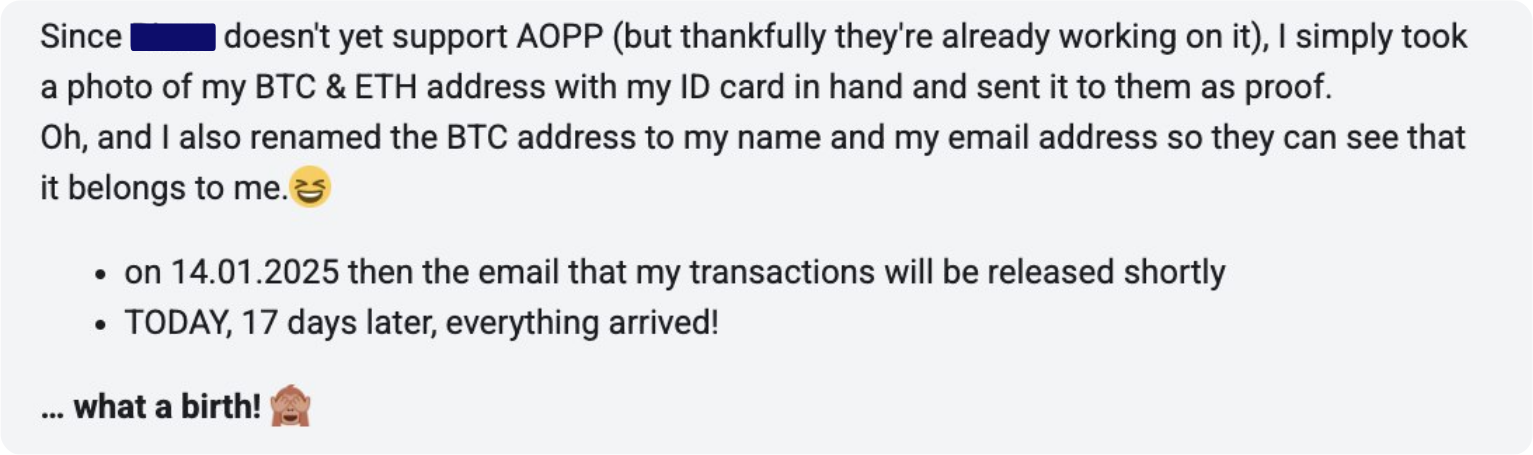
Together, these customer experiences highlight how AOPP delivers a seamless user experience while providing a speedy outcome for wallet owners wishing to withdraw their assets.
AOPP Solves the Proof-of-Ownership Issue
Proving wallet ownership is a crucial part of the Travel Rule and often a hurdle for compliance teams. Methods such as screenshots are unreliable, manual signing is complicated, and Satoshi Tests are costly and slow.
Delphine Forma, Policy Lead at Solidus Labs, told Cointelegraph: “AOPP could solve the cumbersome proof of ownership issue.” Her statement highlights how AOPP directly addresses these issues.
With AOPP, the process can only be initiated by the wallet owner and is completely automated for both VASPs and customers. In turn, AOPP offers a faster, safer, and Travel Rule-compliant solution that eliminates the risks of malware attacks, prevents address reuse, and reduces friction compared to manual alternatives.
Learn more about self-hosted wallet proof methods.
Final Thoughts
It comes as no surprise that competitors have challenged AOPP’s ease of implementation, user experience, and whether it meets global Travel Rule compliance standards.
One criticism raised by the competitor is: “Years after its introduction, AOPP remains implemented in only a small segment of cryptocurrency wallets.”
However, this claim does not hold. AOPP supports over 540 wallets, and the number is continuously growing. Additionally, regulatory concerns are equally unfounded, as AOPP is 100% compliant with the Travel Rule, having even been mentioned in legislation.
Furthermore, unlike other approaches, which are costly, slow, and error-prone, AOPP is completely automated with no manual review component. It prevents address reuse, and proof of ownership can be proved in seconds.
In short, AOPP solves the issue of proof of self-hosted wallet ownership for VASPs and their customers and sets the standard for secure and efficient Travel Rule compliance.
See a proof of ownership with AOPP in real time with various wallets. Request a demo.